

Ground transportation is currently the fastest-changing category in corporate travel, accounting for nearly 18% of total travel spend. Yet despite its size, it remains one of the least controlled and least standardized areas of most corporate travel programs.
Historically treated as an unmanaged tail spend, ground travel is now heavily driven by rapid shifts in technology, traveler behavior, and dynamic pricing models. Leaving this category unmanaged exposes organizations to unbudgeted cost inflation, operational friction, and serious compliance vulnerabilities.
Centralized Rideshare Platforms & Expense Leakage
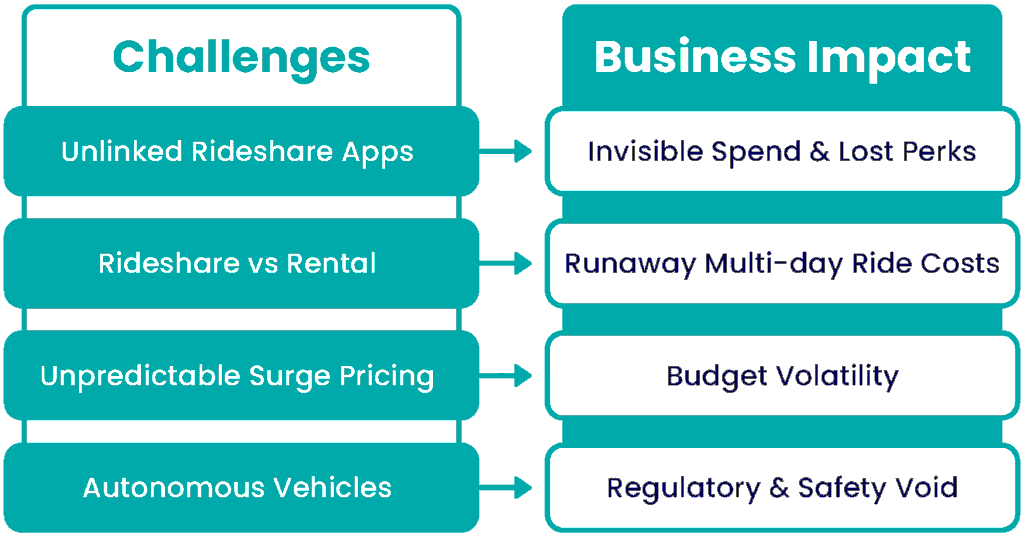
Uber for Business and Lyft Business have evolved significantly, offering centralized billing, automated expense tracking, and corporate controls. However, many organizations fail to enforce integrated corporate profiles. When employees book through personal app accounts and submit manual receipts, ground spend becomes virtually invisible to finance teams. This off-channel leakage deprives the organization of benefits including Uber One memberships, volume rebates for mid to larger accounts, inflates administrative expense-processing costs, and obscures audit trails needed to catch duplicate or out-of-policy claims.
Balancing Rideshare with Managed Rental Car Programs
While rideshare offers unrivaled convenience for point-to-point airport transfers and single-meeting trips, relying on it as a default for all travel creates major financial inefficiencies. On multi-day, multi-stop, or suburban trips, taking individual rideshares quickly becomes exponentially more expensive than a corporate rental car. A sound ground policy balances convenience and cost: it leverages rideshares for short, urban, point-to-point trips, while steering travelers toward preferred car rental vendors, complete with negotiated rates, waived secondary-driver fees, and built-in damage coverage, for multi-day or long-distance travel.
Dynamic Pricing and Budget Volatility
Rideshare algorithms dynamically adjust fares based on weather, local traffic, and high-demand events. Without clear policy caps or approved vehicle tiers, a route that costs $30 on a calm Tuesday morning can easily balloon by two to three times that cost during peak airport rush hours or rainstorms. This unmanaged volatility leads to sudden budget creep, making quarterly travel forecasting unreliable for financial planning teams.
Autonomous Vehicles (AVs) and Unregulated Risk
Self-driving services like Waymo are actively operating across major metropolitan markets, and business travelers are already using them. Most corporate travel policies offer zero guidance on autonomous transit, leaving a dangerous gap in risk strategy. Allowing unmanaged AV usage exposes the company to complex legal and insurance gray areas, specifically around liability limits, corporate coverage, and traveler safety protocols if an autonomous system encounters a critical failure.
The Bottom Line
Ground transportation may represent the smallest percentage of category travel spend, but it is becoming one of the most dynamic categories to manage. By modernizing your oversight today, you do more than plug financial leaks and mitigate emerging technology risks; you turn an unpredictable, fragmented process into a streamlined, cost-effective program that works for both your financial bottom line and your travelers.